B21, China Town Mall, Midrand

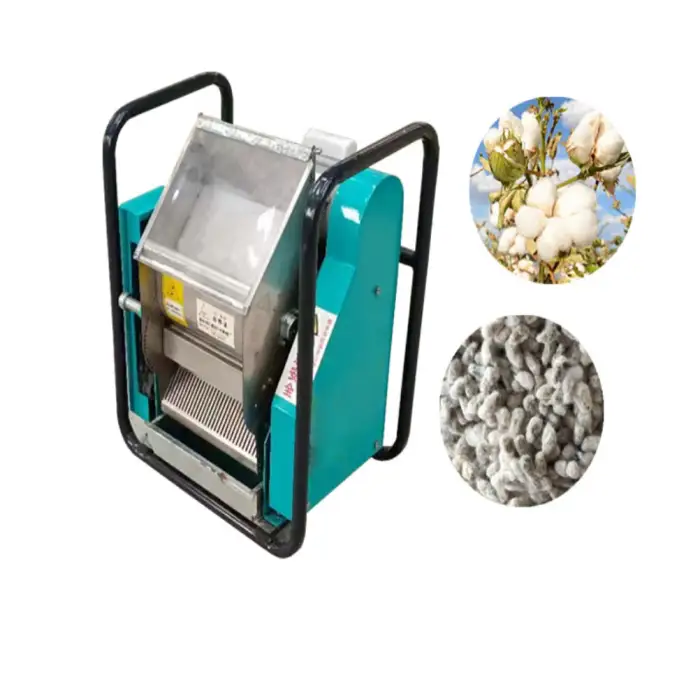
test Cotton Ginning Equipment Gin Machine Cotton Seed Extractor Machinery

- Section : Machinery
- Category : Industrial Machinery
- SKU : 1600576684537

test Cotton Ginning Equipment Gin Machine Cotton Seed Extractor Machinery
The test Cotton Ginning Equipment Gin Machine Cotton Seed Extractor Machinery is designed for efficient cotton processing. This machine helps separate cotton fibers from seeds quickly and effectively. With a compact design and powerful performance, it is ideal for small to medium-sized operations.
Specifications
| Attribute | Details |
|---|---|
| Voltage | 220V |
| Capacity | 500g/15 seconds |
| Power | 260-550W |
| Speed | 1250 RPM |
| Weight | 20 kg |
| Dimensions (L*W*H) | 340*320*340 mm |
| Number of Saw Blades | 8 pcs / 11 pcs / 10 pcs |
Key Features
- Compact design for easy handling.
- Fast processing speed for high efficiency.
- Multiple saw blade options for different needs.
- Robust motor for reliable performance.
- Comes with a machinery test report for quality assurance.
Applications
- Cotton farming and production.
- Small-scale cotton processing facilities.
- Research labs for cotton studies.
- Educational purposes in agricultural programs.
- Home use for hobbyists interested in cotton processing.
Product Info Gallery
- Shipping Timeframes: All orders are processed within 2-5 business days (excluding weekends and holidays). After your order has been processed, the estimated delivery time is before 31 Aug, 2026, depending on customs, Please note that due to high demand, some items may experience longer shipping times, which will be communicated at order confirmation email.
- Order Processing Time: Please allow 2-5 business days for us to process your order before it is shipped . Orders placed after 16:00 on Fridays, or during weekends and public holidays, will begin processing on the next business day. Processing times may be extended during peak seasons or sales events.
- Manufacturing Time: Some products needs manufacturing time, the manufacturing process will take approximately 10-30 business days depending on the product. This timeframe may vary depending on the complexity of the product and current demand. but this will be communicated with you during order confirmation.
- Returns and Exchanges: We offer a 30-day return policy for most items. If you are not completely satisfied with your purchase, you may return it within 30 days of receipt for a refund or exchange. Items must be unused, in their original packaging, and accompanied by proof of purchase. Return shipping costs are the responsibility of the customer, unless the item was damaged or defective upon arrival.
1. What is the test Cotton Ginning Equipment Gin Machine Cotton Seed Extractor Machinery?
A compact cotton ginning machine designed to separate cotton fibers from seeds quickly and efficiently for small to medium-sized operations, labs, educational use and hobbyists.
2. What are the key specifications of this machine?
Voltage: 220V; Capacity: 500 g / 15 seconds (≈2 kg/min, ~120 kg/hr theoretical); Power: 260–550 W; Speed: 1250 RPM; Weight: 20 kg; Dimensions (L×W×H): 340×320×340 mm; Number of saw blades: 8 / 10 / 11 pcs.
3. What processing capacity should I expect in practical terms?
Rated capacity is 500 g every 15 seconds (about 2 kg per minute). Actual throughput can vary with cotton variety, moisture, feed technique and duty cycle; test with your material to determine real-world rates.
4. What power supply do I need and what is the power consumption?
The machine requires a 220 V AC supply and draws between 260 and 550 W depending on load and configuration. Make sure your circuit has the appropriate rating and protection (fuse or breaker).
5. What are the saw blade options and how do I choose between 8, 10 or 11 blades?
Three saw-blade configurations are offered (8, 10, 11). Blade count affects ginning aggressiveness and throughput; higher blade counts can be better for finer separation on some varieties. Choose based on cotton type, desired fiber quality and throughput—consult the supplier for recommendations.
6. Is this machine suitable for home use or research labs?
Yes. Its compact size and capacity make it well suited for small-scale farms, research labs, educational programs and hobbyists. For commercial large-scale ginning, larger industrial machines are recommended.
7. What is included with the machine purchase?
The machine comes with a machinery test report for quality assurance. Typical packages include the gin machine and standard blades; contact the seller to confirm the exact components, manuals and any accessories included.
8. How do I install and set up the machine?
Place the machine on a stable, level surface with adequate ventilation and clearance. Secure any mounting if required, connect to a proper 220 V supply, check blade installation and tightness, and run an initial no-load test per the user manual. Follow all safety and electrical regulations.
9. What routine maintenance is required?
Regularly remove lint and debris, inspect and clean saw blades and housing, lubricate moving parts as indicated in the manual, check belt/tension and fasteners, and replace worn or damaged blades and components. Perform inspections more frequently under heavy use.
10. How do I replace or service the saw blades?
Always disconnect power before servicing. Remove the protective cover, loosen and remove fastening hardware, replace blades with compatible parts, ensure correct alignment and balance, re-tighten hardware to spec and replace the cover. Run a low-speed test to check for vibration.
11. What safety precautions should I follow when operating this machine?
Keep hands and loose clothing away from moving parts, wear appropriate PPE (gloves, eye protection), disconnect power before maintenance, do not overload the feed, keep children and untrained persons away, and follow all warnings and procedures in the user manual.
12. Can the machine run continuously for long periods?
The machine is designed for frequent use, but continuous long-term operation may require periodic cool-downs and maintenance. Duty cycle depends on load and environment—consult the supplier or manual for recommended continuous operation limits.
13. What certifications or quality assurances come with the product?
The product includes a machinery test report for quality assurance. For additional certifications (CE, ISO, etc.), contact the seller to confirm which standards and certificates are provided for your region.
14. Are spare parts and after-sales service available?
Spare parts and after-sales support availability vary by seller and region. Contact the supplier or manufacturer to confirm availability of replacement blades, motors, service centers and warranty terms.
15. How is the machine packaged and shipped, and what are lead times?
Packaging and shipping options vary by seller. The machine is compact (20 kg, 340×320×340 mm) and typically ships in protective packaging. Contact the seller for shipping methods, lead times, customs requirements and freight costs.
Latest Order Arrivals
Discover our latest orders

12 Heads Embroidery Machine

Toilet Paper Machine Machine

Order Collection

Cross Border Clients

Order cros border countries Collected

Industrial Machine Cllection

Agriculture Processing Machines

Ready for collection

Water Pump Equipment

Packaging Machine and accessories

Fabrics Manufacturing Equipment

Mining Equipments

Food Processing Machine

Batch of Orders

Batch of Orders

Latest Orders Labelled

wheel alignment machines

new arrivals

Pre Orders Offloading

Latest Arrivals

Latest Arrivals

Latest Arrivals

Loading

Toilet paper making machine

Toilet paper making machine

Toilet paper Rewinding Machine

latest arrivals

offloading

order success

order collection

order offloading