B21, China Town Mall, Midrand

Fast Heating Speed Induction Hardening Machine for Gears, Rollers, Engine Parts, Aircraft, and Rockets.
Asset finance available
Do you want funding for this equipment?
Afrimart can connect you with trusted funding partners who specialise in asset finance for businesses like yours. Compare options and apply in minutes — final approval is subject to provider review.
Check funding options
Secure & no obligation

- Section : Machinery
- Category : Metal & Metallurgy Machinery
- SKU : 1600900181172

Products Description:

vertical induction hardening machine :
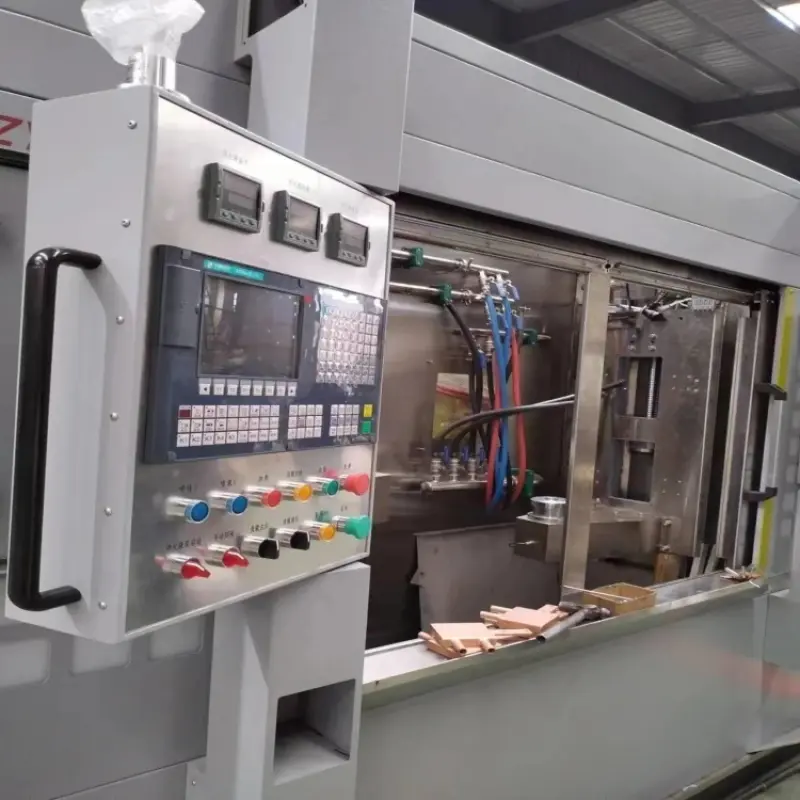
This series of induction hardening machine is suitable for all kinds of shaft parts continuous scanning heating hardening,simultaneous heating hardening,segmented scanning heating hardening ,segmenting simultaneous heating hardening.
Advantages:
1.Surfaces can be hardened in a very short time of period.2.Hardened depth is adjustable.
3.Heating of limited areas is possible.
4.Hardening achieved at very low cost.
5.Uniform, high-quality hardening is obtained.
Product Paramenters
| Specifications: | Parameters: |
| Workpiece length,max. | 1000 mm |
| Workpiece dia.max. | 500 mm |
| Workpiece weight,max. | 500KG |
| Generators | 100~600 KW |
| X-axis travel,max. | 200mm |
| Y-axis travel,max. | 200mm |
| Z-axis travel | 0~1000mm |
Applications for devices


Gear hardening Shaft hardening Turning tool welding Bit welding


Gear hardening Sprocket hardening Rail hardening Crankshaft quenching


Large modulus single tooth quenching Steering gear rack quenching Heat the teeth of shield Heat reinforce


Bit welding Special shaped parts conductance heating Cutting tooth welding Internal hole hardening
Product Comparison

Others intermediate frequency power supply harmonic
Our intermediate frequency power supply harmonic
- Shipping Timeframes: All orders are processed within 2-5 business days (excluding weekends and holidays). After your order has been processed, the estimated delivery time is before 04 Aug, 2026, depending on customs, Please note that due to high demand, some items may experience longer shipping times, which will be communicated at order confirmation email.
- Order Processing Time: Please allow 2-5 business days for us to process your order before it is shipped . Orders placed after 16:00 on Fridays, or during weekends and public holidays, will begin processing on the next business day. Processing times may be extended during peak seasons or sales events.
- Manufacturing Time: Some products needs manufacturing time, the manufacturing process will take approximately 10-30 business days depending on the product. This timeframe may vary depending on the complexity of the product and current demand. but this will be communicated with you during order confirmation.
- Returns and Exchanges: We offer a 30-day return policy for most items. If you are not completely satisfied with your purchase, you may return it within 30 days of receipt for a refund or exchange. Items must be unused, in their original packaging, and accompanied by proof of purchase. Return shipping costs are the responsibility of the customer, unless the item was damaged or defective upon arrival.
1. What is the Fast Heating Speed Induction Hardening Machine used for?
It's a vertical induction hardening machine designed for rapid, localized hardening of shaft-type components and other parts such as gears, rollers, engine parts, aircraft and rocket components. It supports continuous scanning, simultaneous heating, segmented scanning and segmented simultaneous heating methods.
2. What kinds of parts and applications is this machine suitable for?
Typical applications include gear hardening, shaft hardening, sprocket and rail hardening, crankshaft quenching, steering rack and rack-and-pinion quenching, single-tooth hardening, welding/repair of cutting teeth and bits, internal hole hardening and other special-shaped ferrous parts.
3. What are the maximum workpiece size and weight limits?
Maximum workpiece length is 1000 mm, maximum diameter is 500 mm and maximum workpiece weight is 500 kg.
4. What power options does the machine offer?
The machine is supplied with intermediate-frequency generators in the range of 100–600 kW, selectable to match the application and cycle requirements.
5. How fast is the heating and hardening process?
The machine provides very fast surface heating and hardening cycles—surfaces can be hardened in a very short period of time compared with traditional methods—enabling high throughput and reduced cycle times for many shaft and gear processes.
6. Can the hardened depth and hardened area be controlled?
Yes. Hardened depth is adjustable and the system enables heating of limited or localized areas (teeth, faces, shoulders, internal bores) with precise control over the hardened zone.
7. What motion and positioning capability does the machine have?
Axis travels are X-axis up to 200 mm, Y-axis up to 200 mm and Z-axis 0–1000 mm, enabling accurate scanning and positioning for continuous or segmented hardening operations.
8. What materials can be induction hardened with this machine?
The equipment is primarily intended for ferrous materials such as carbon and alloy steels commonly used in gears, shafts and crankshafts. Non-ferrous metals (aluminum, copper, etc.) generally cannot be hardened by induction.
9. What quenching options are supported?
The system is designed to integrate with standard quenching media and quench delivery systems for rapid cooling after induction heating. Specific quench system configuration (spray, immersion, or localized quench) is selected based on the part geometry and process requirements.
10. How does this machine compare to other induction hardening systems?
Advantages include very fast surface heating, adjustable hardened depth, ability to harden limited areas at low cost and consistent high-quality results. The offered intermediate-frequency power supply is engineered for improved harmonic performance and efficiency versus some conventional intermediate-frequency units.
11. What level of process repeatability and quality can I expect?
The machine is built to provide uniform, high-quality hardening with repeatable results when process parameters (power, scan speed, coil design and quench) are controlled and recipes are used for a given part.
12. Is the machine automated and how is it controlled?
Typical systems include servo or CNC control for axis motion and PLC/HMI interfaces for recipe management, power control and process monitoring. Custom automation options (robot loading/unloading, part handling) can be integrated to meet production needs.
13. What are the installation requirements (power, cooling, footprint)?
Installation requires a high-power three-phase electrical supply sized to the selected generator (100–600 kW), adequate industrial cooling (water supply and return for power electronics and coils), and floor space for the machine, quench system and part handling. Exact requirements depend on configuration and should be confirmed with the supplier.
14. What safety and maintenance features are included?
Standard provisions include guarding and interlocks, emergency stops, thermal and electrical protection for the power supply, and accessible service points. Routine maintenance typically covers coil inspection, cooling system checks and power supply preventive maintenance.
15. Can the machine be customized for special parts or production volumes?
Yes. Coils, power rating, quench systems, fixturing and automation can be customized to suit special geometries, higher throughput requirements or specific process targets. Work with the manufacturer to define part-specific coil designs and process recipes.
Latest Order Arrivals
Discover our latest orders

12 Heads Embroidery Machine

Toilet Paper Machine Machine

Order Collection

Cross Border Clients

Order cros border countries Collected

Industrial Machine Cllection

Agriculture Processing Machines

Ready for collection

Water Pump Equipment

Packaging Machine and accessories

Fabrics Manufacturing Equipment

Mining Equipments

Food Processing Machine

Batch of Orders

Batch of Orders

Latest Orders Labelled

wheel alignment machines

new arrivals

Pre Orders Offloading

Latest Arrivals

Latest Arrivals

Latest Arrivals

Loading

Toilet paper making machine

Toilet paper making machine

Toilet paper Rewinding Machine

latest arrivals

offloading

order success

order collection

order offloading