B21, China Town Mall, Midrand

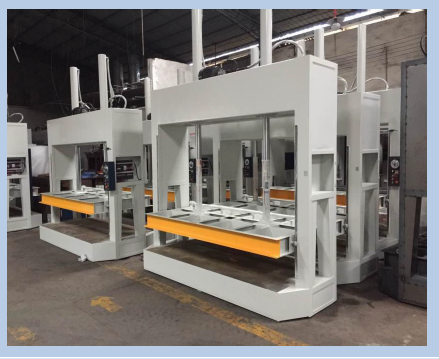
50 Tons Cold Press Woodworking Machine
Asset finance available
Do you want funding for this equipment?
Afrimart can connect you with trusted funding partners who specialise in asset finance for businesses like yours. Compare options and apply in minutes — final approval is subject to provider review.
Check funding options
Secure & no obligation

- Section : Machinery
- Category : Woodworking Machinery
- SKU : 1600875091193

Product Description
- Shipping Timeframes: All orders are processed within 2-5 business days (excluding weekends and holidays). After your order has been processed, the estimated delivery time is before 08 Aug, 2026, depending on customs, Please note that due to high demand, some items may experience longer shipping times, which will be communicated at order confirmation email.
- Order Processing Time: Please allow 2-5 business days for us to process your order before it is shipped . Orders placed after 16:00 on Fridays, or during weekends and public holidays, will begin processing on the next business day. Processing times may be extended during peak seasons or sales events.
- Manufacturing Time: Some products needs manufacturing time, the manufacturing process will take approximately 10-30 business days depending on the product. This timeframe may vary depending on the complexity of the product and current demand. but this will be communicated with you during order confirmation.
- Returns and Exchanges: We offer a 30-day return policy for most items. If you are not completely satisfied with your purchase, you may return it within 30 days of receipt for a refund or exchange. Items must be unused, in their original packaging, and accompanied by proof of purchase. Return shipping costs are the responsibility of the customer, unless the item was damaged or defective upon arrival.
1. What is a 50 Tons Cold Press Woodworking Machine?
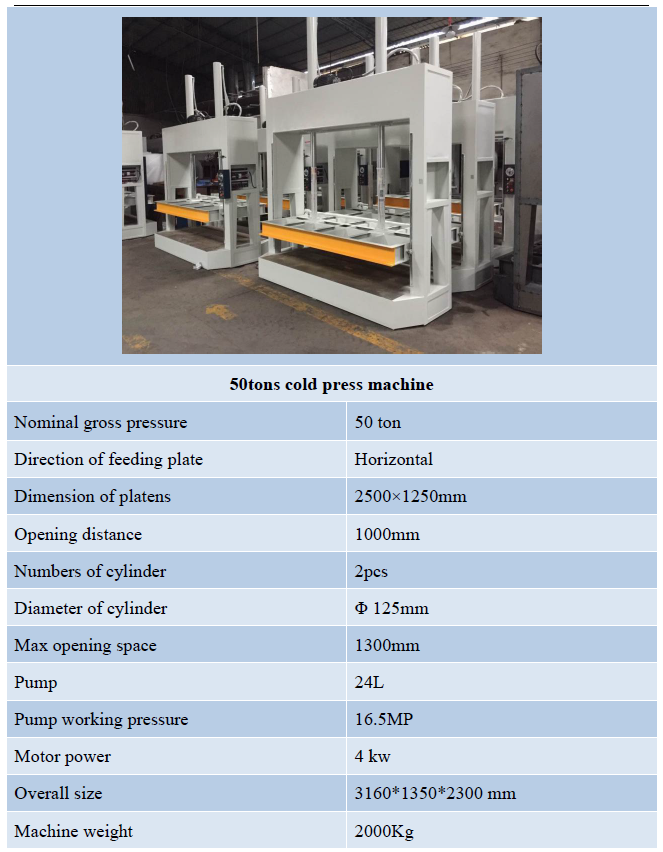
A 50 Tons Cold Press is a hydraulic press used in woodworking to apply steady pressure (50 tons capacity) for laminating, veneering, bonding panels, cold-pressing veneer, and other adhesive processes that do not require heat.
2. What materials and processes is this machine suitable for?
Common uses include laminating decorative surfaces, veneering plywood, bonding MDF, particleboard, HPL/laminate sheets, edge gluing, and assembling multi-layer panels where pressure rather than heat is required.
3. What does '50 tons' mean in practical terms?
It refers to the maximum clamping force the hydraulic system can deliver—approximately 50 metric tons of force (roughly 490 kN). Actual usable pressure on a part depends on platen size and how the load is distributed.
4. What are the typical platen sizes and can they be customized?
Platen sizes vary by model and manufacturer. Many suppliers offer several standard sizes and can provide custom platen dimensions or segmented platens and fixtures to suit specific panel sizes and production needs. Check the manufacturer's datasheet for available options.
5. How fast is the press cycle?
Cycle time depends on the application, adhesive cure time, and operator. For simple clamping and laminating cycles, pressure reach and release can be under a minute; full adhesive curing may require several minutes to hours off-press. Consult process guidelines for your adhesive.
6. What power supply and hydraulic requirements are needed?
Hydraulic and electrical specifications vary by model. Many machines use three-phase electrical supply and an onboard hydraulic power unit. Exact motor power, voltage, and hydraulic flow/pressure specs will be provided by the manufacturer—confirm before purchase.
7. Is installation and commissioning included with the machine?
Policies differ by supplier. Some include installation, testing and operator training at the buyer's site (often for larger orders or with a service fee). Confirm installation, commissioning and travel costs with the seller prior to purchase.
8. What safety features should I expect?
Typical safety features include emergency stop buttons, safety guards or light curtains, pressure relief valves, overload protection, and interlocks to prevent platen movement while guards are open. Always follow local safety regulations and provide operator training.
9. How much maintenance does the machine require?
Routine maintenance includes daily cleaning, periodic checks of hydraulic fluid level and condition, inspecting hoses and seals, greasing moving parts, and scheduled hydraulic oil/filter changes. Follow the manufacturer's maintenance schedule for intervals.
10. Are spare parts and service available?
Most reputable suppliers provide spare parts, consumables (seals, valves), and service contracts or field service technicians. Ask about lead times for critical parts and availability in your region before buying.
11. Can the press be fitted with accessories or custom tooling?
Yes. Common accessories include segmented platens, vacuum attachments, custom fixtures/jigs, pressure distribution pads, and automated loading/unloading systems. Discuss your production requirements to determine necessary tooling.
12. What are the shipping dimensions and weight?
Shipping size and weight depend on the model and optional equipment. Because these machines can be heavy and bulky, suppliers will usually provide shipping weights and crate dimensions; ask for these details to plan transport and site access.
13. What warranty and after-sales support are typically offered?
Warranties commonly range from 12 months for parts and workmanship; extended warranties and service packages are often available for purchase. Confirm warranty terms, what is excluded, and response times for service calls with the vendor.
14. Do you provide operator training and process support?
Many manufacturers or dealers offer operator training (onsite or remote), process setup assistance, and troubleshooting support. Training topics usually include safe operation, maintenance, and best practices for adhesives and materials.
15. How do I choose between a cold press and a heated (hot) press?
Choose a cold press when your bonding process requires only pressure and ambient temperature (e.g., contact adhesives, certain PVA/urethane glues, veneering). Use a heated press for thermosetting adhesives or processes that require elevated temperature to cure or laminate (e.g., certain melamine or phenolic applications). Evaluate your materials and adhesives to determine which is appropriate.
Latest Order Arrivals
Discover our latest orders

12 Heads Embroidery Machine

Toilet Paper Machine Machine

Order Collection

Cross Border Clients

Order cros border countries Collected

Industrial Machine Cllection

Agriculture Processing Machines

Ready for collection

Water Pump Equipment

Packaging Machine and accessories

Fabrics Manufacturing Equipment

Mining Equipments

Food Processing Machine

Batch of Orders

Batch of Orders

Latest Orders Labelled

wheel alignment machines

new arrivals

Pre Orders Offloading

Latest Arrivals

Latest Arrivals

Latest Arrivals

Loading

Toilet paper making machine

Toilet paper making machine

Toilet paper Rewinding Machine

latest arrivals

offloading

order success

order collection

order offloading